HDR vs. Standard Photography: What's the Difference?
A home can look bright, open, and inviting when you are standing inside it—and surprisingly dark or washed out when photographed.
This is one of the first things many real estate agents and homeowners discover when they try to photograph a property themselves.
You walk into a beautiful living room in The Villages. Sunlight is streaming through the sliding glass doors. The golf course looks fantastic outside. The room feels comfortable and bright.
You take a photograph.
Suddenly the room looks dark.
So you brighten the picture.
Now the room looks better, but the golf-course view has disappeared into a nearly white window.
What happened?
Nothing is wrong with the house, and there may be nothing wrong with the camera.
The problem is simply that a camera does not see light in exactly the same way your eyes do.
That is where HDR real estate photography becomes valuable.
HDR—High Dynamic Range—is one of the techniques professional real estate photographers can use to create bright, balanced photographs while preserving detail in both the lightest and darkest areas of a room.
But HDR is also widely misunderstood.
Done correctly, you should barely notice it was used.
Done poorly, you certainly will.
So let's look at the difference between HDR and standard photography, when each can work, and why the photographer's skill matters far more than simply turning on an HDR setting.
Why Real Estate Interiors Can Be Difficult to Photograph
Before talking about HDR, it helps to understand the problem it is designed to solve.
Your eyes are remarkably good at adapting to changing light.
Stand in a living room and look toward a bright window. You can usually see the sofa, walls, flooring, and furniture inside the room while also seeing trees, landscaping, a pool, or a golf course outside.
Your eyes and brain are constantly adjusting.
A camera has a more difficult job.
When one part of a photograph is very bright and another part is much darker, the camera has to decide how to expose the scene.
That difference between the brightest and darkest areas is called dynamic range.
And real estate photography is full of scenes with a tremendous dynamic range.
Homes throughout The Villages and Central Florida often have:
Large windows
Sliding glass doors
Florida rooms
Screened lanais
Pools
Golf-course views
Water views
Bright white kitchens
Open floor plans
Strong Florida sunlight outside
Those features are wonderful for buyers.
They can also be challenging for a camera.
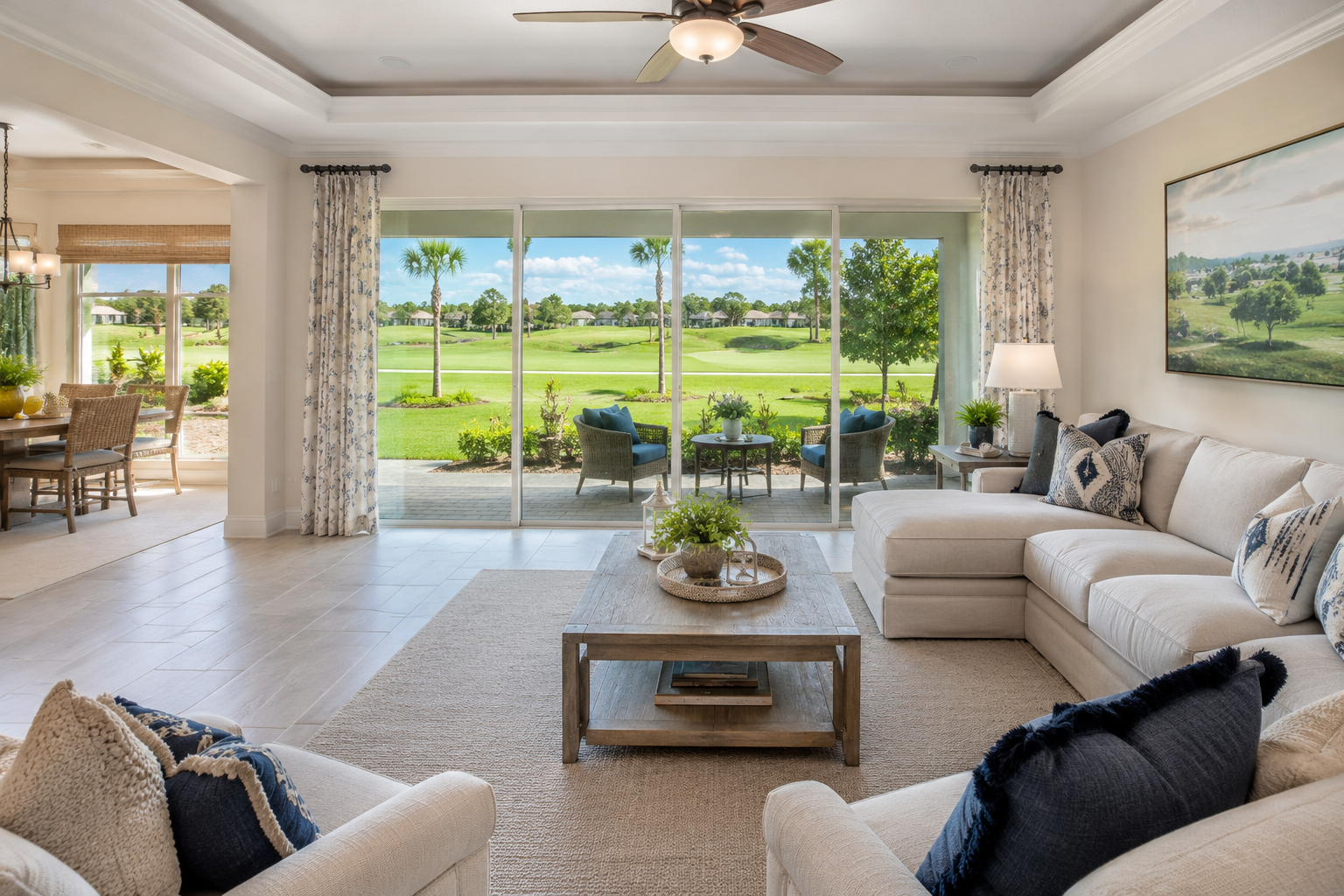
Professional HDR photography can balance a bright outdoor view with a naturally lit interior.
What Is Standard Real Estate Photography?
In its simplest form, standard photography uses one exposure to create the photograph.
The photographer chooses camera settings that determine how much light reaches the camera's sensor and takes the picture.
In balanced lighting conditions, a single exposure can produce a beautiful result.
For example, an exterior photographed under soft evening light may not require multiple exposures.
A room with even lighting and limited contrast between the windows and interior may also photograph very well with a single image.
Modern professional cameras are capable of capturing an impressive amount of detail.
But every camera has limits.
Imagine photographing a living room with a large sliding glass door overlooking a sunny backyard.
If the photographer exposes the image for the room, the interior may look bright and attractive—but the outside view may become almost completely white.
Expose for the outside view instead, and the landscaping may look perfect while the living room becomes dark.
The photographer is essentially trying to fit two very different lighting conditions into one photograph.
Sometimes that works.
Sometimes it does not.
What Is HDR Photography?
HDR stands for High Dynamic Range.
Rather than depending entirely on one exposure, the photographer captures multiple photographs of the exact same composition at different brightness levels.
A simplified example might include:
One darker photograph to preserve bright highlights and window views
One normal exposure for the middle tones
One brighter photograph to capture detail in darker areas
Additional exposures may be used when necessary.
Those photographs are then blended together during professional editing.
The final image can contain detail that would have been difficult to capture in a single photograph.
Dark areas remain visible.
Bright areas retain detail.
Window views can remain recognizable.
And the entire room can appear much closer to what someone remembers seeing while standing inside it.
That last point is important.
Good HDR photography is not supposed to make a home look artificial.
It should help the photograph look natural.
A Simple HDR vs. Standard Photography Example
Consider a living room overlooking a golf course.
It is 11:00 in the morning.
Florida sunshine is pouring through the sliding glass doors.
With a Single Exposure
Expose for the interior and the room may look beautiful, but the golf course outside could disappear into a bright white area.
Expose for the golf course and the outdoor scenery may look perfect, but the interior could become too dark.
A photographer can recover some information during editing, but there is a limit to how much detail exists in one exposure.
With HDR
The photographer captures several exposures without moving the camera.
The darker exposure preserves the view through the glass.
The brighter exposure preserves details in the room's shadows.
The middle exposure provides the foundation.
Those photographs are carefully blended.
The result can show both the comfortable interior and the golf-course view.
And if that view is one of the reasons someone would buy the house, that matters.
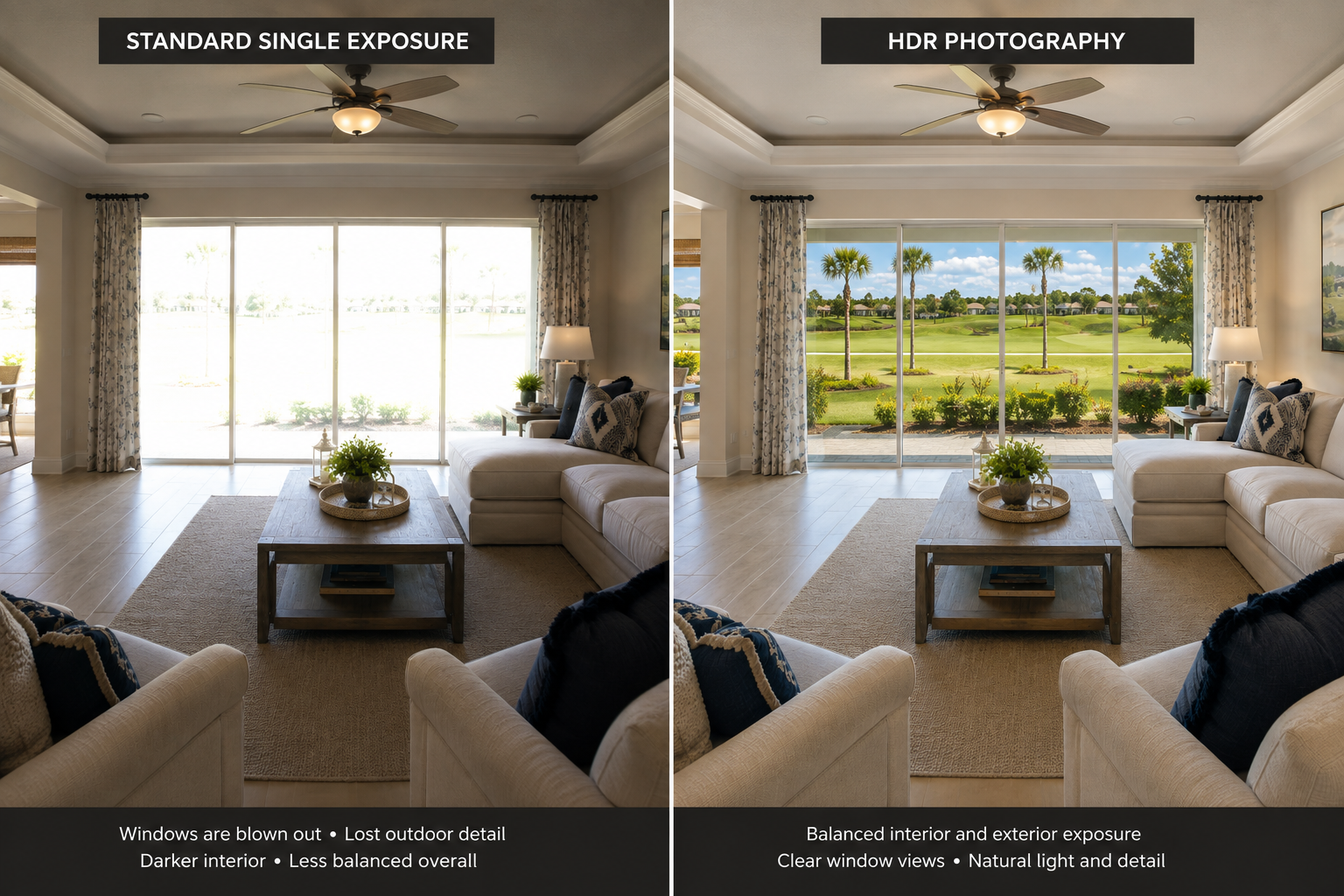
A single exposure can struggle with bright windows, while HDR gives the photographer more information to create a balanced final image.
HDR Shouldn't Look Like HDR
This may be the most important section of the chapter.
HDR photography developed a bad reputation because it was sometimes used to create extremely dramatic images.
You may have seen them.
Skies become electric blue.
Grass turns unnaturally green.
Wood floors become orange.
Shadows disappear completely.
Walls develop strange halos.
Windows look like someone cut out another photograph and pasted it into the room.
Everything is technically visible—but nothing looks believable.
That is not the goal of professional real estate HDR photography.
The home should still look like the home.
A gray wall should look gray.
A white kitchen should look white.
Wood should retain natural brown tones.
Outdoor landscaping should look natural.
Windows should contain believable detail.
And shadows should still exist.
Shadows are not the enemy.
They give furniture, cabinets, walls, and architectural features depth.
Remove every shadow and a room can begin to look flat and artificial.
The objective isn't to eliminate contrast.
It is to control it.
Our Approach: Light, Bright and Real
At S & R Real Estate Photography, our editing philosophy can be summarized in three words:
Light. Bright. Real.
We want a home to look its best without turning it into something buyers will not recognize when they arrive for a showing.
That means we are looking for:
Bright, inviting rooms
Clean whites
Neutral wall colors
Natural wood tones
Open but realistic shadows
Controlled highlights
Visible window detail when appropriate
Natural contrast
Accurate colors
A polished but believable appearance
The purpose of editing isn't to show buyers how talented the editing software is.
The purpose is to help them notice the property.
When professional real estate photography is done well, the photographic technique disappears.
The kitchen gets the attention.
The lanai gets the attention.
The view gets the attention.
The home gets the attention.
That's exactly what we want.
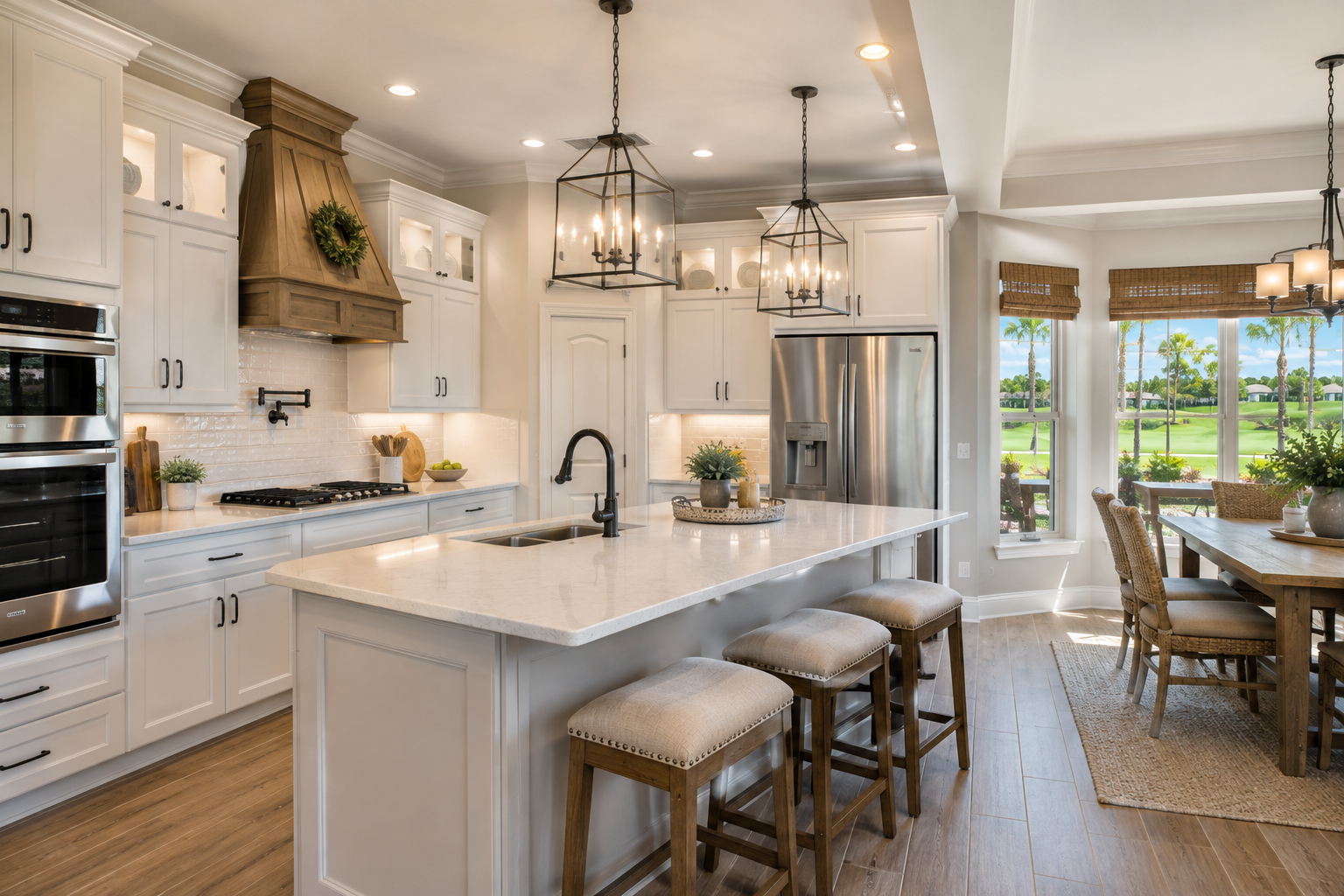
Good HDR editing keeps whites clean, shadows natural, and details visible without making the kitchen look overprocessed.
Why Window Views Matter So Much in The Villages
This is where our local market deserves special attention.
Many homes in The Villages have outdoor features that are an important part of the property's appeal.
Maybe the home backs onto a golf course.
Maybe it has a water view.
Maybe the lanai overlooks beautiful landscaping.
Maybe the homeowner has created an attractive outdoor living space.
These features should not disappear simply because the interior of the home requires a brighter exposure.
Imagine marketing a golf-front home while every photograph facing the golf course has completely white windows.
Technically, you photographed the room.
But you missed part of the story.
HDR photography gives us an opportunity to preserve that connection between the interior and exterior.
A buyer can see the living room and understand what is beyond those sliding doors.
That creates context.
And context helps buyers understand how they might actually experience the property.
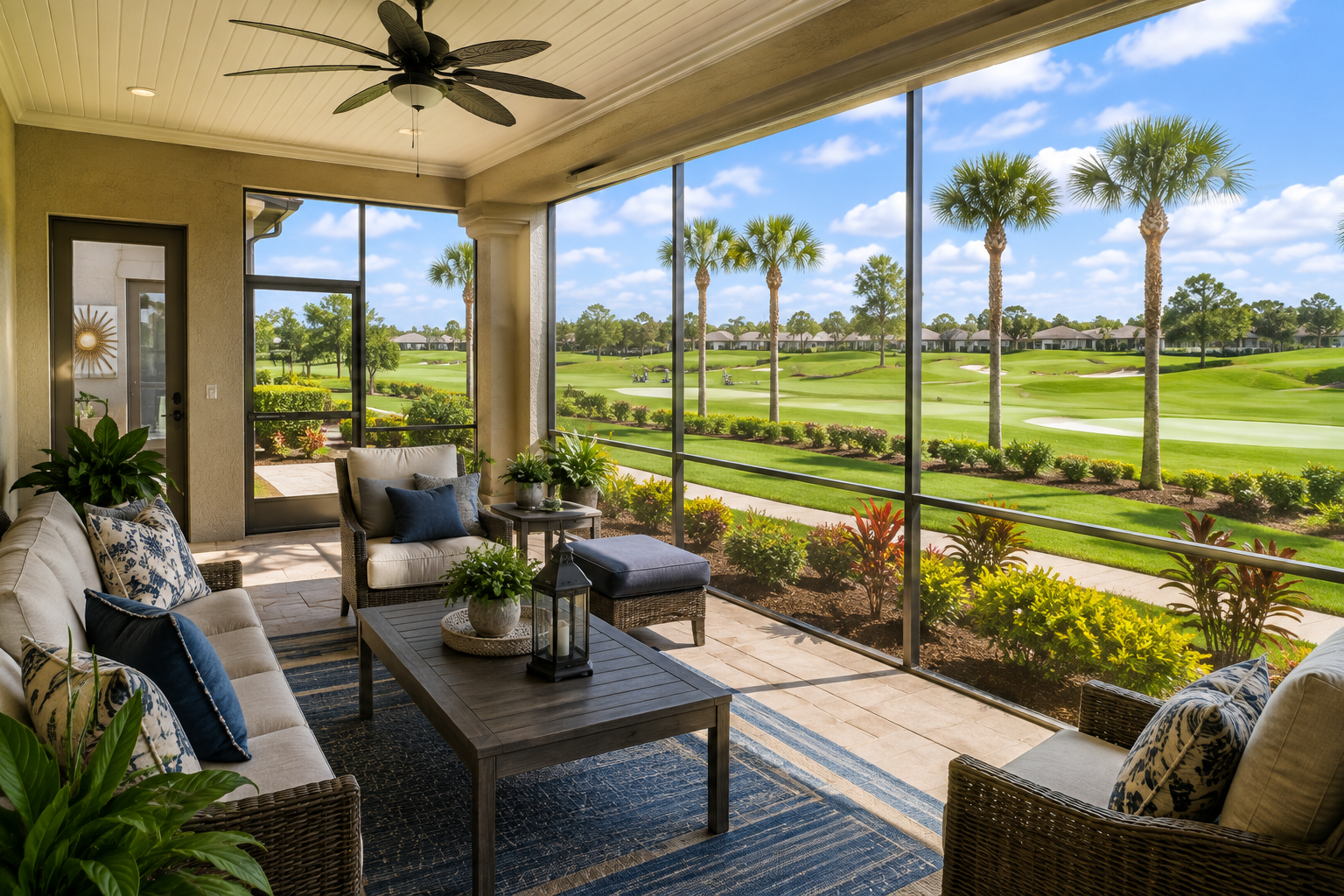
Outdoor views are often major selling features in The Villages and should remain visible without looking artificial.
HDR Isn't Just About Making Rooms Brighter
Brightness gets most of the attention, but HDR gives a photographer control over much more than that.
Consider a kitchen.
You may have:
White cabinets
Dark countertops
Stainless-steel appliances
Pendant lights
Under-cabinet lighting
Dark flooring
Bright windows
Every one of those surfaces reacts differently to light.
If the photograph is simply brightened globally, the cabinets may become too bright while other areas still look dark.
HDR provides additional information that allows the photographer to create a more controlled result.
The same applies to bathrooms, bedrooms, dining rooms, Florida rooms, and enclosed lanais.
The goal isn't:
Make everything bright.
The goal is:
Put the right amount of brightness in the right places.
That distinction is part of professional editing.
Does Every Real Estate Photograph Need HDR?
No.
And this is where technique should never become more important than judgment.
There are situations where a carefully photographed single exposure is exactly what is needed.
Exterior photographs taken under beautiful light may work wonderfully from one exposure.
Rooms with soft, balanced lighting may not require extensive exposure blending.
A photographer may also use supplemental lighting, flash techniques, or other blending methods when those approaches produce a better result.
HDR is a tool.
It isn't a rule.
The best photographers choose the technique based on the property and the scene in front of them.
Agents don't need every photograph produced the same way.
They need consistent results.
Professional HDR Is More Than a Camera Setting
Many smartphones and cameras now include an HDR mode.
That leads to a reasonable question:
If my phone can take HDR photographs, why hire a professional?
Because HDR is only one small part of creating the image.
The photographer still needs to decide:
Where should the camera be positioned?
How high should it be?
Which direction best shows the room?
How wide should the photograph be?
Are the vertical lines straight?
Does the furniture arrangement work from this angle?
Are reflections becoming distracting?
Should the ceiling fan be on or off?
Should the blinds be adjusted?
How much window detail looks natural?
Are the walls actually the correct color?
Does the image feel bright enough?
Does it still look believable?
HDR does not answer those questions.
A photographer does.
And after the photographs are captured, editing introduces another set of decisions involving exposure, color, perspective, contrast, highlights, shadows, and distractions.
A button can combine photographs.
It cannot understand the home.
What Buyers Should Notice
Ideally, nothing we've discussed in this chapter should be what a potential buyer thinks about while looking at the listing.
They shouldn't think:
"That's excellent exposure blending."
They should think:
"That's a beautiful kitchen."
"Look at that lanai."
"I like how bright the living room is."
"You can see the golf course from there."
"I want to see this house."
That is the real purpose of professional photography.
Every technical decision should ultimately support that response.
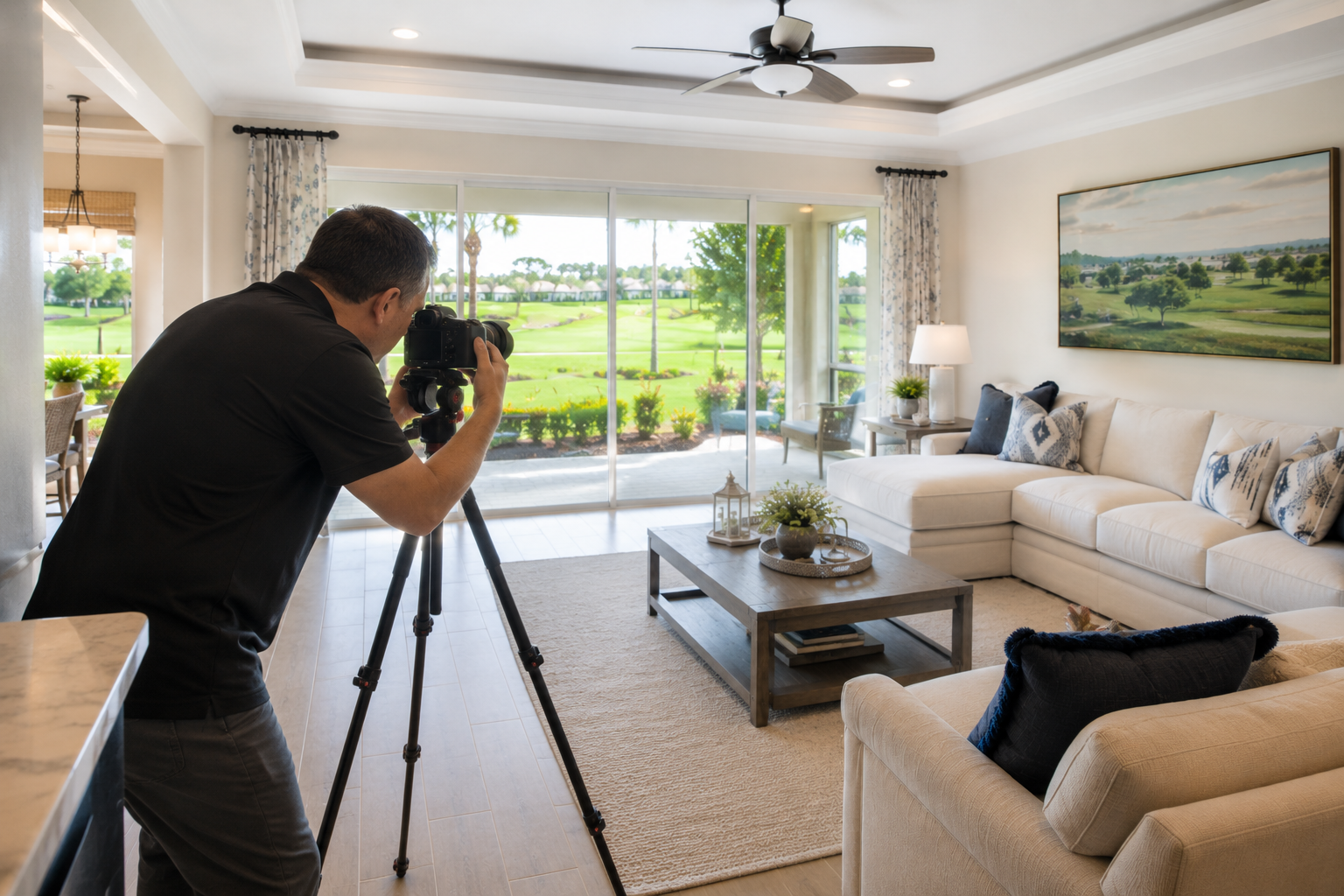
HDR is only one part of professional real estate photography. Composition, perspective, lighting, and editing all contribute to the final image.
HDR vs. Standard Photography: Which Is Better?
It would be easy to end this chapter by saying HDR is always better.
But that wouldn't be accurate.
A beautifully photographed and edited single exposure is better than poorly processed HDR.
The photographer's judgment matters more than the label attached to the technique.
For many interiors, however—especially Florida homes with large windows and bright outdoor scenery—HDR gives a professional photographer much more information to work with.
And that can mean:
Better-controlled highlights
More detail in darker areas
More natural window views
Brighter-looking interiors
Better representation of architectural features
More consistent photographs throughout the listing
For homes in The Villages, that flexibility can be especially useful because indoor and outdoor living often blend together.
The photograph needs to communicate both.
The Bottom Line
Standard photography captures a single exposure.
HDR photography captures several exposures and gives the photographer more information from which to create the finished image.
But the number of exposures is not what makes the photograph professional.
The decisions made before, during, and after those exposures are what matter.
The best HDR real estate photography does not look heavily edited.
It looks natural.
It allows buyers to see the room.
It preserves important details.
It helps them understand the view.
And most importantly, it lets the home itself remain the star of the photograph.
That's the difference between simply documenting a property and intentionally presenting it.
And that brings us to another question that has become increasingly common:
If today's smartphones take such impressive pictures, does the camera really matter anymore?
Or could an agent photograph an entire listing with a phone and get essentially the same result?
That's where we're headed next.
Continue Reading
Upcoming Article
Drone Photography That Sells Homes
Some of a home's most valuable features simply cannot be shown from ground level. Aerial photography can reveal the property's location, surrounding neighborhood, golf-course or water views, landscaping, lot size, and other features that help buyers understand the complete setting.
In Chapter 4 of The S & R Real Estate Marketing Guide, we’ll look at how professional drone photography can add a new perspective to a listing, highlight features buyers may otherwise miss, and help a property stand out in a crowded online market.
Coming Next — Chapter 4: Drone Photography That Sells Homes
Related Articles
About the Author:
Scott Ledbetter is the photographer behind S & R Real Estate Photography, serving real estate agents, homeowners, and property professionals throughout The Villages and surrounding Central Florida communities.
S & R Real Estate Photography provides professional real estate photography and visual marketing services designed to present homes in a clean, natural, and compelling way. Services include professional interior and exterior photography, HDR photography, aerial drone photography, Matterport 3D tours, Zillow Showcase media, and additional listing-marketing solutions.
Our philosophy is simple:
Professional photographs should make buyers want to experience the property in person—and when they arrive, the home should still feel like the home they saw online.
S & R Real Estate Photography
The Villages & Surrounding Central Florida Communities
407-616-7510